Marble vs Granite vs Quartzite: A Straight Answer
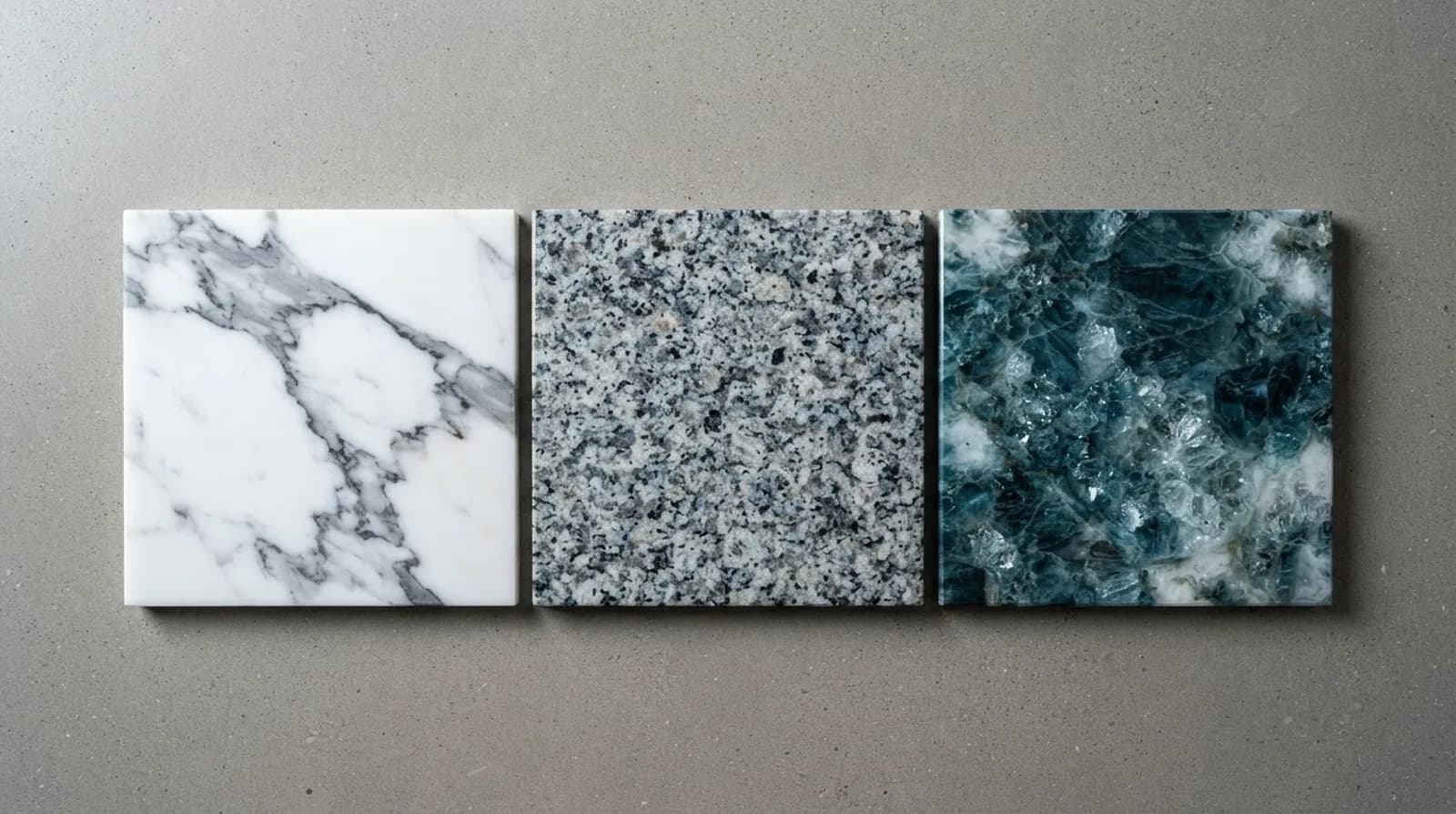
Three stones, three completely different materials. Here is what each one does under a hot pan, a squeezed lemon and ten years of daylight.
7 min read
In this guide
Most people arrive at this comparison with the wrong question. They ask which stone is hardest, when the property that decides their satisfaction is usually chemistry, not hardness.
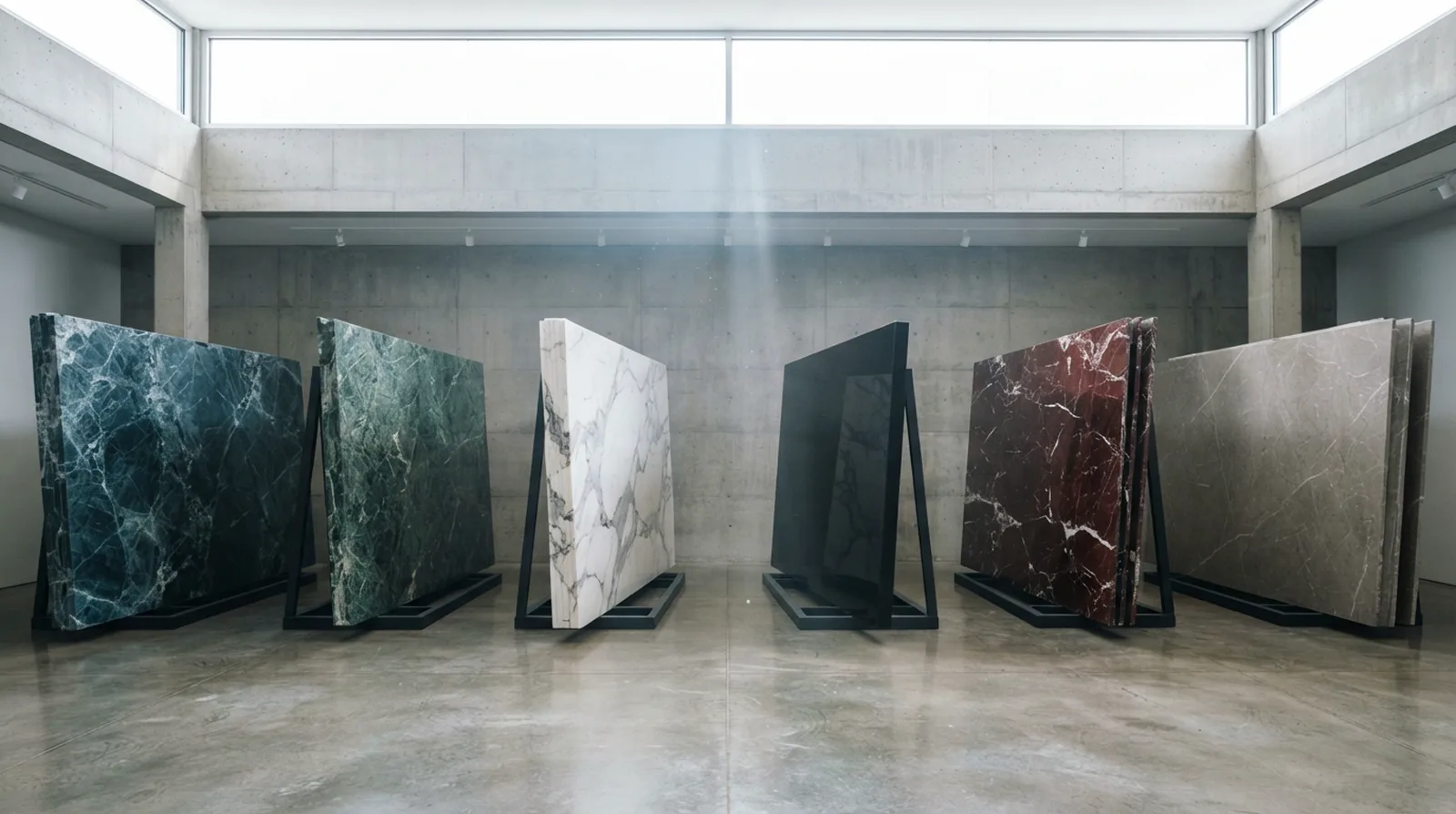
Here is the short version. Granite is the toughest and the least demanding. Quartzite matches it for durability and beats it for drama. Marble is the most beautiful of the three and the only one that reacts to what you cook with.
What each stone actually is
The differences on site all trace back to how each stone was formed, so it is worth thirty seconds of geology.
- Marble is metamorphosed limestone. Its mineral is calcite soft, and chemically reactive to acid.
- Granite is igneous: magma that cooled slowly underground into interlocking crystals of quartz, feldspar and mica. No veins, no acid reactivity, very hard.
- Quartzite is metamorphosed sandstone. Heat and pressure fused loose quartz grains into a single mass. It carries marble-like movement with quartz-grade hardness.
Etching is not scratching
This is the distinction that decides the whole comparison, and almost nobody is told it before they buy.
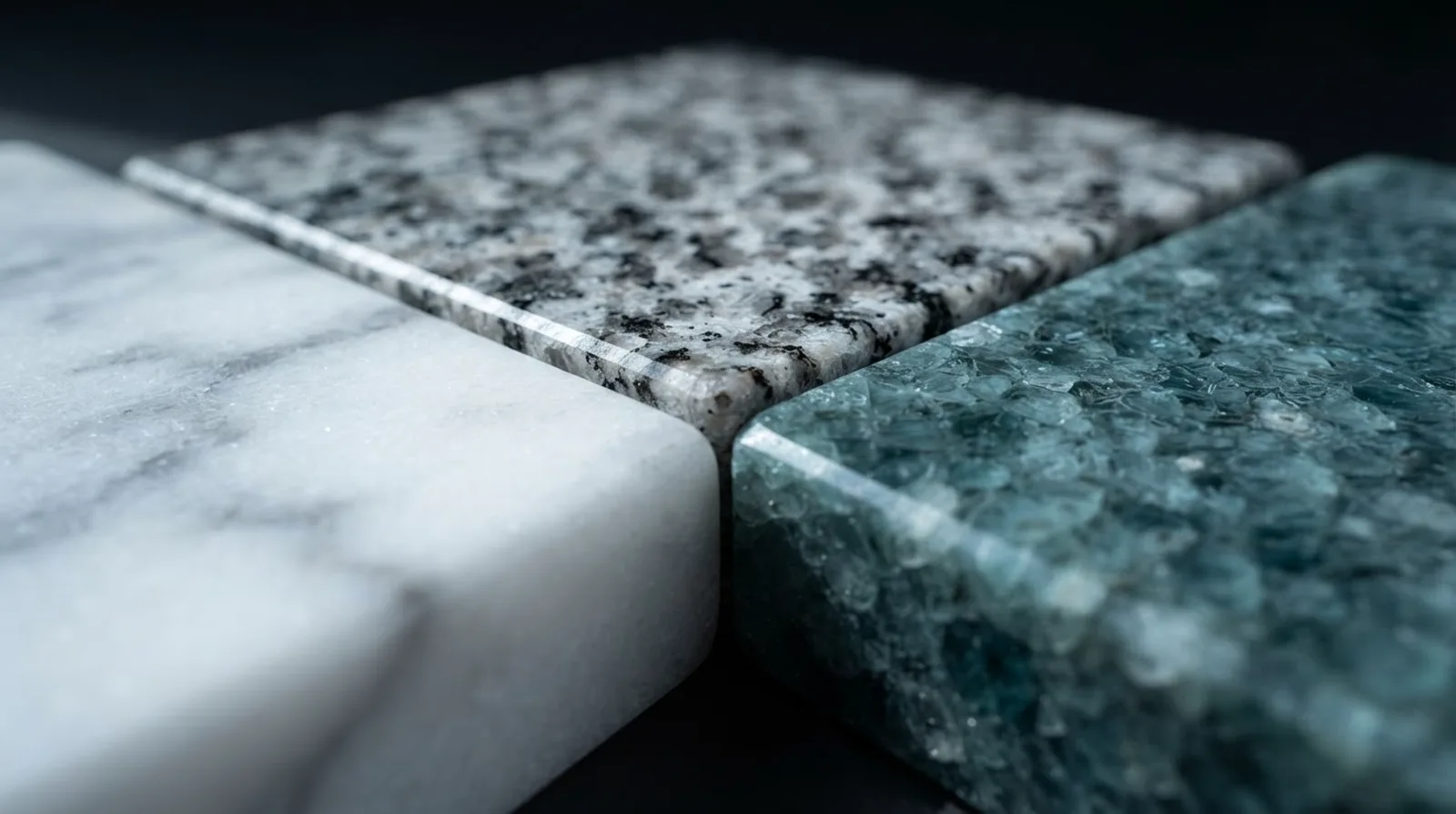
A scratch is mechanical a knife, a dragged pan, grit under a vase. A stone's hardness resists it. Etching is chemical: an acid dissolves a microscopic layer of the surface and leaves a dull, slightly paler mark. Hardness does not help at all.
Marble is calcite, so lemon juice, vinegar, wine, tomato, cola and most bathroom cleaners etch it often within seconds, on a polished finish, in the shape of the splash. Granite and quartzite are quartz-based and simply do not react.
None of this rules marble out. A honed finish hides etching far better than a polish, and plenty of people genuinely like the patina a marble kitchen develops. It just has to be a decision, not a surprise.
Hardness, porosity and heat
| Marble | Granite | Quartzite | |
|---|---|---|---|
| Mohs hardness (typical) | 3 – 4 | 6 – 7 | 7 |
| Porosity | Medium – high | Low | Low – very low |
| Reacts to acid | Yes | No | No |
| Hot pan straight from the hob | Risky thermal shock and marking | Fine | Fine |
| Knife directly on the surface | Marks the stone | Blunts the knife | Blunts the knife |
| Sealing | On install, then roughly annually | On install, then every 2 – 4 years | On install, then every 2 – 4 years |
| UV / colour stability outdoors | Fair can yellow or dull | Excellent | Excellent |
On heat: granite and quartzite both take a hot pan without complaint. The usual advice to use a trivet anyway is about the sealer and the joint adhesive, not the stone. Marble is more fragile here a sudden temperature change on a polished surface can leave a permanent dull patch.
What each one costs to live with
Purchase price is only the opening position. Commercial granite is generally the least expensive of the three per square foot and the cheapest to own. Marble spans an enormous range from economical domestic marble to Italian Statuario and carries the highest ongoing cost, because it wants resealing more often and eventually wants repolishing. Imported quartzite is usually the most expensive to buy and among the cheapest to maintain.
Add the fabrication reality too. Quartzite is hard enough that cutting and profiling it takes longer and wears tooling faster, so fabrication quotes run higher than the same job in marble. Ask for the fixed price, not the slab price.
Buy on the delivered-and-fixed price. The slab rate is the smaller half of the number.
So which one, where?
| Application | First choice | Why | Also works |
|---|---|---|---|
| Working kitchen countertop | Granite | Acid-proof, heat-proof, low maintenance | Quartzite |
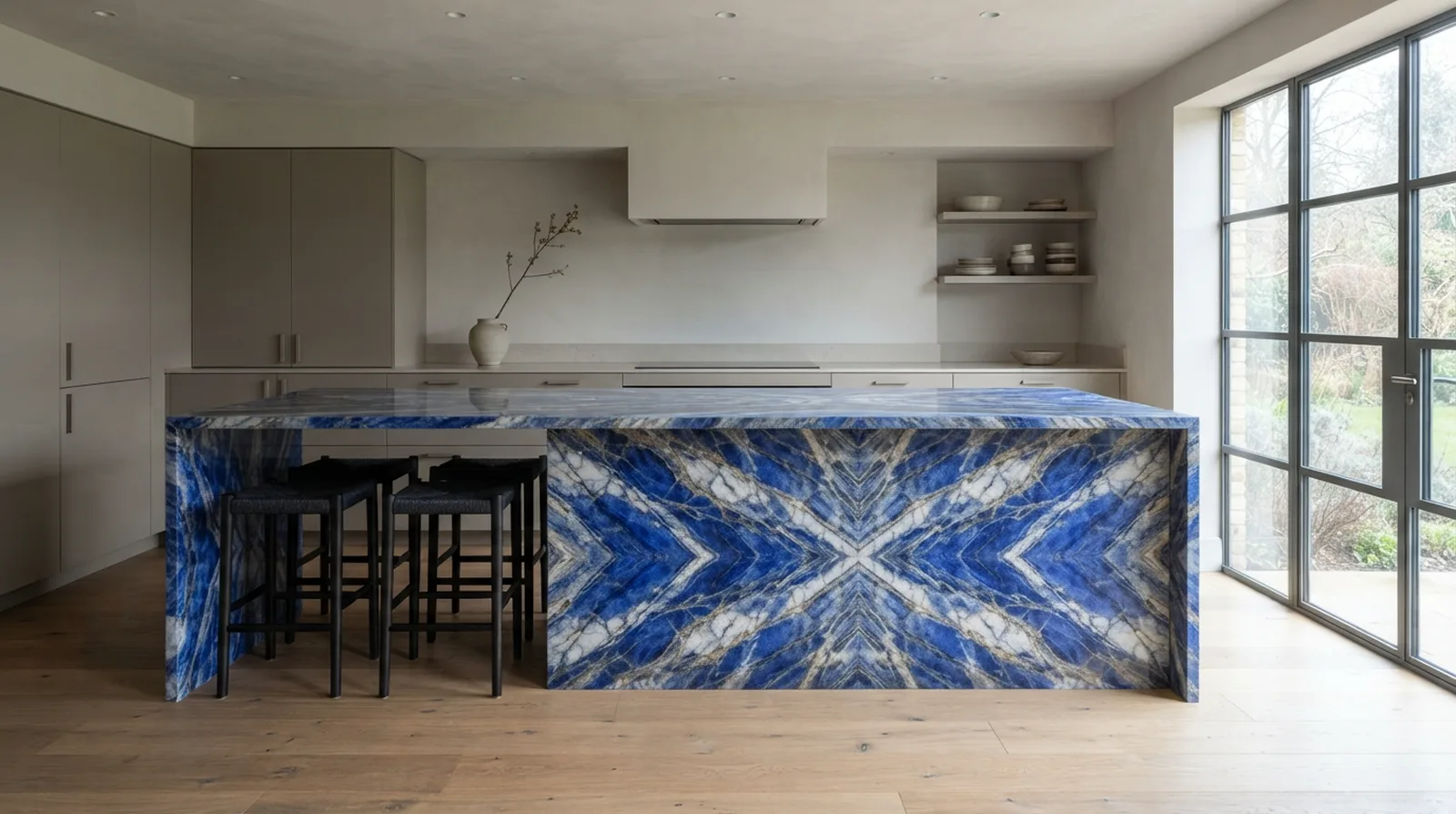
| Statement island | Quartzite | Marble-like drama that survives real use | Granite |
| Bathroom vanity | Marble | Low acid exposure; the look is the point | Quartzite |
| Shower walls | Marble | Vertical, low wear, book-matches beautifully | Quartzite |
| Living room floor | Marble | Large-format calm underfoot | Granite |
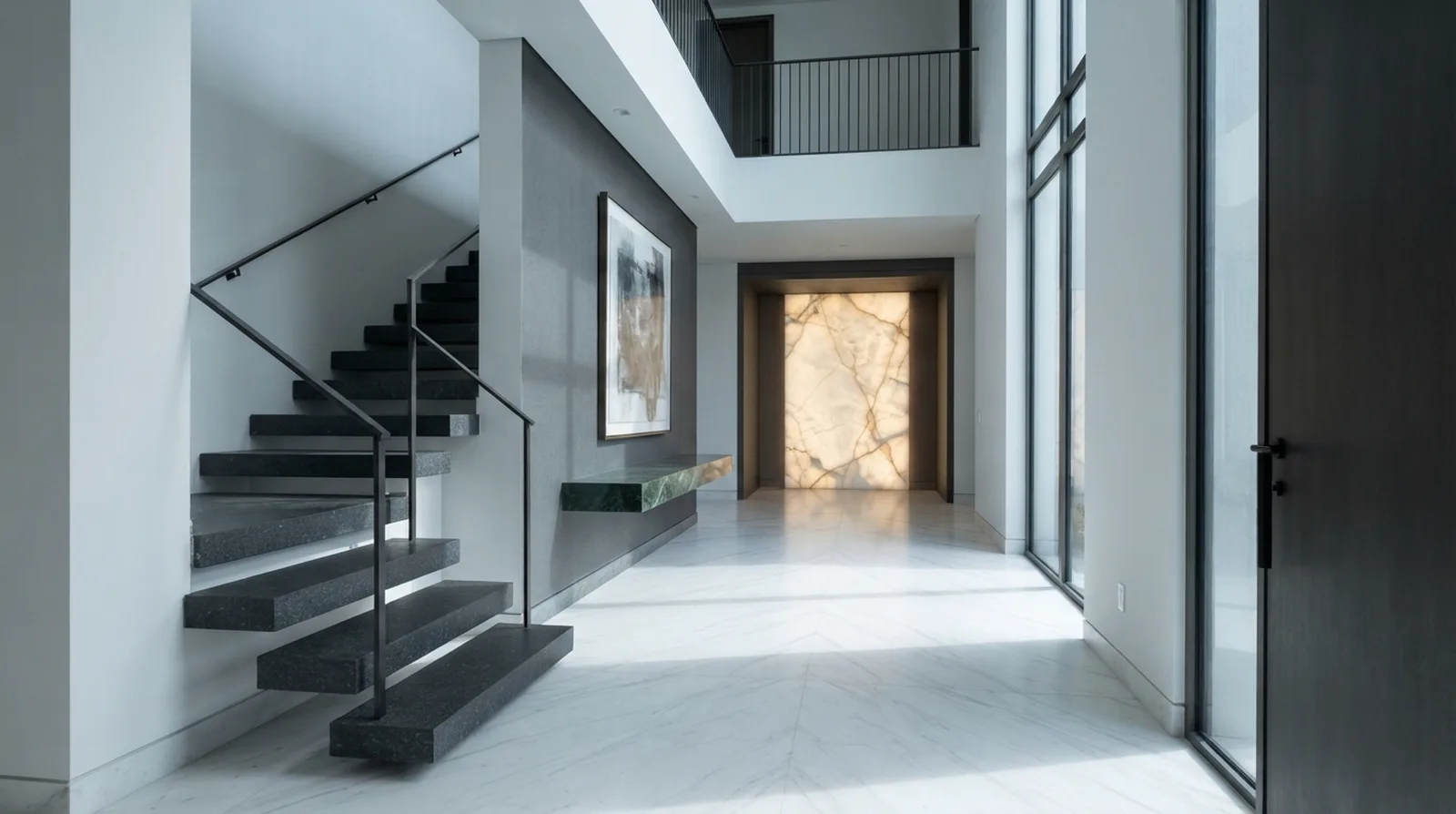
| Staircase | Granite | Takes edge wear and grit | Marble |
| Restaurant / commercial | Granite | Repeatable, tough, cheap to maintain | Quartzite |
| Outdoor paving | Granite | Flamed finish, UV and weather stable | Quartzite |
| Feature wall | Quartzite | Book-matching and backlighting | Marble |
Frequently asked questions
- Is quartzite the same as quartz?
- No, and the names cause real confusion. Quartzite is a natural stone quarried in slabs. Engineered quartz is a manufactured product roughly 90% ground quartz bound in resin sold under brand names. Quartzite is more heat resistant; engineered quartz is more uniform and non-porous.
- Will granite crack if I put a hot pan on it?
- Almost never. Granite handles cooking temperatures comfortably. The rare failures come from a very localised heat source on a slab that already had a fissure, or from heat degrading the sealer rather than the stone.
- Can etched marble be repaired?
- Yes. Light etching on a honed surface can often be buffed out with a marble polishing powder. Deeper etching on a polished surface needs a professional to re-hone and re-polish that area. Neither is difficult it is just recurring work.
- Which stone is best if I want the marble look but hate maintenance?
- Quartzite. White quartzites such as Cristallo and Mont Blanc read very close to marble and behave like granite. Verify it is genuine quartzite before you buy several soft dolomitic marbles are sold under quartzite names.
- Does granite stain?
- Rarely, but it can. Lighter and more porous granites will absorb oil if left unsealed and unwiped. A sealer on installation and a re-seal every few years handles it.